

Artificial intelligence has transformed how companies analyze data and understand their consumers.
But not all AI models are created equal.
The difference between a generic AI, built to process any type of text, and a proprietary AI, designed for specific contexts and languages, can be what separates surface-level information from strategic insight.
In this article, we explore what sets these approaches apart — and why specialized models are now essential for brands seeking a deeper understanding of consumer language and behavior.
What Is Generic AI?
Generic AI models are designed to respond to a wide range of questions and process data from any domain.
They are powerful systems, trained on large and diverse datasets — from academic papers to social media posts.
This means they have a broad understanding of language, but lack contextual depth in specialized areas such as consumer emotions, motivations, or cultural habits.
In market research, generic AI can provide fast analyses but often misses subtle nuances of tone, intention, irony, or cultural expression — leading to less precise interpretations.
What Is Proprietary AI?
Proprietary AI, on the other hand, is developed and trained for a specific domain.
In consumer analysis, this means calibrating the model to recognize linguistic patterns, sentiments, and behaviorsunique to the target audience.
Rather than trying to understand everything, proprietary AI focuses on understanding deeply — for example, how Latin American consumers talk about brands, products, or experiences.
These models can also be continuously refined with real research data, ensuring they evolve and maintain accuracy over time.
Key Differences Between Generic and Proprietary AI
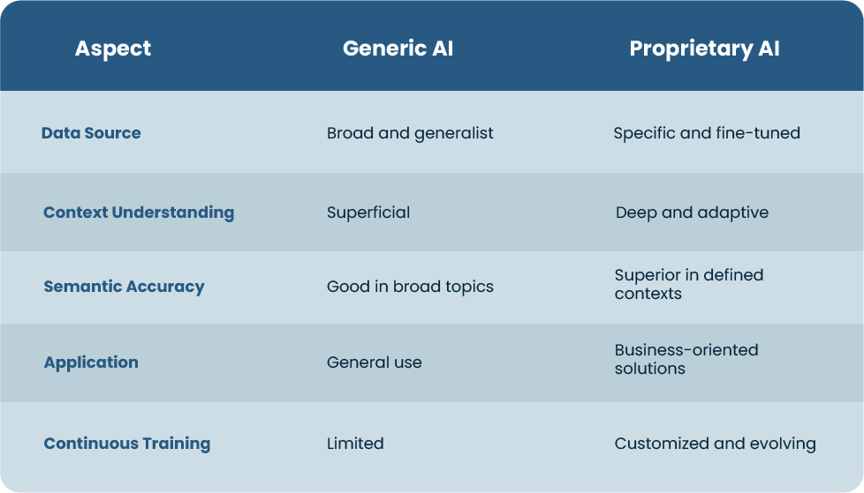
Why Specialization Drives Better Insights
-
Contextual Understanding
It interprets language and consumer behavior in specific markets, recognizing regional expressions and cultural sentiments.
-
Greater Semantic Precision
It identifies subtle tones, intentions, and emotions that generic models often overlook.
-
Adaptation to Market Changes
Proprietary models can be updated with new research data, ensuring analyses remain relevant to consumer realities.
-
Strategic Relevance
They generate insights that reflect business context, empowering marketing and innovation teams to make better-informed decisions.
When to Use Each Type of AI
- Generic AI is useful for broad applications — automated customer service, information retrieval, or large-scale content generation and review.
- Proprietary AI, however, is the best choice when the goal is to understand consumers deeply, interpret sentiment, and uncover market opportunities.
In research projects, campaigns, and language analysis, this precision can be decisive.
Why This Matters Especially in Latin America
Latin America is a linguistic and cultural mosaic.
Words, slang, and expressions vary widely across countries, regions, and even social groups.
Generic AI models often fail to capture these nuances, while proprietary AIs trained on local contexts can interpret what people truly mean — not just what they write.
This ability to translate language into genuine insight is what makes proprietary AI a game-changer in culturally diverse regions.
In Summary
What is a Generic AI?
A model trained on massive, varied datasets to understand language broadly — but without deep contextual awareness.
What is a Proprietary AI?
An AI model developed and fine-tuned for a specific domain, capable of capturing nuances, meanings, and cultural context.
Conclusion
Choosing between generic and proprietary AI depends on your goal.
When the objective is to understand people, contexts, and cultures, a specialized and context-aware model offers a clear competitive advantage.
In a market that values speed and depth of insight, success depends not just on using AI — but on using the right AI for your business.